Redesigning Howdy's hiring engine to help scale from 300 to 600 Howdy Players
A dual redesign — internal tools for the Ops team and the partner-facing app — built around a single business goal: getting more candidates hired and working actively with partners.
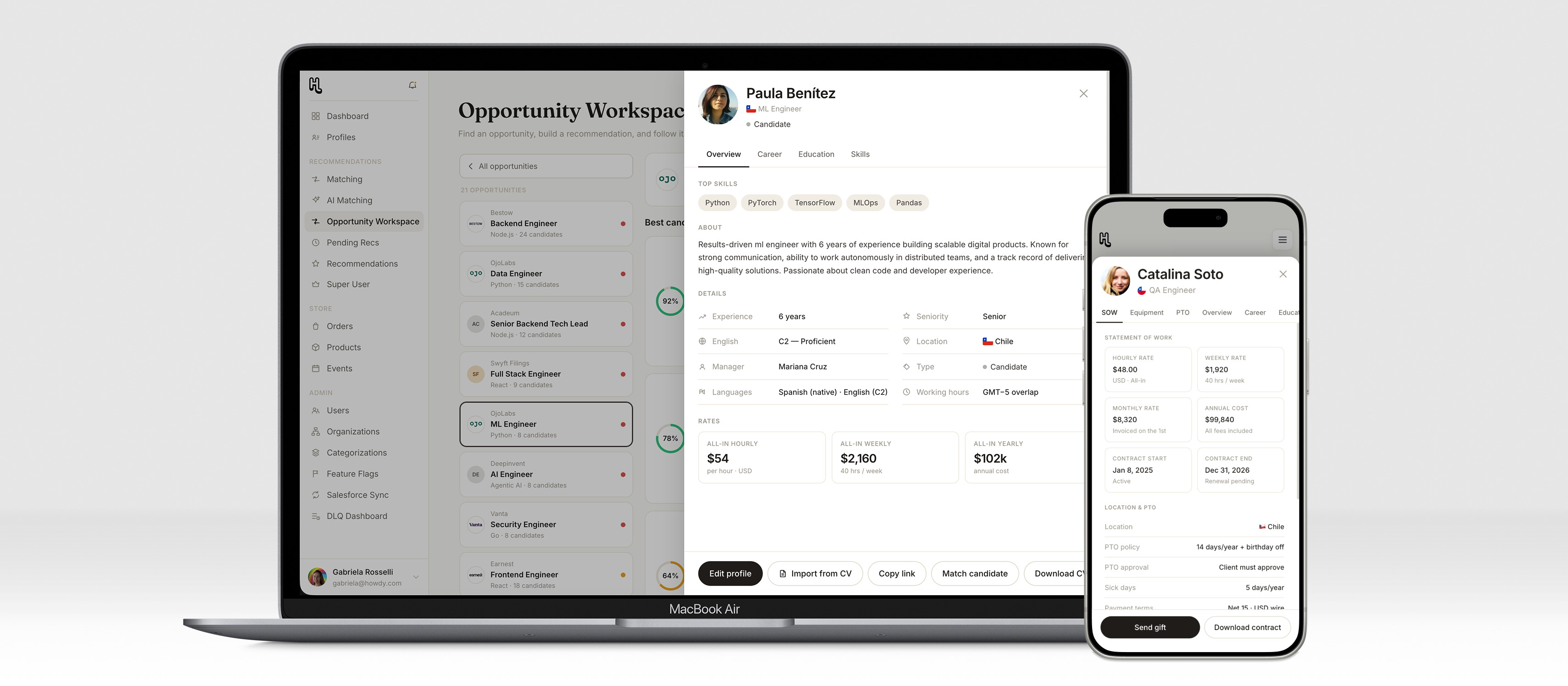
Overview
One metric behind every decision
Howdy connects Latin American tech talent with US companies. The whole business rolls up into a single number: Howdy Players (HP) — candidates who get hired by a partner and are actively working on their team. When I joined, three and a half years ago, the goal was to reach 300 HP. Today, the target is 600.
Getting there meant improving two very different experiences that both feed the same funnel: the internal tools the Ops team (Account Managers, Recruiters, and Profile Creators) uses to source, build, and present candidates — and the partner-facing app companies use to request, evaluate, and hire them. On the internal side, AI became one of the biggest levers — replacing manual, time-consuming steps across the candidate pipeline with automated ones, and freeing up time to focus on presenting more candidates instead of processing them.
Problem
Two products, one shared bottleneck
I started with interviews across every internal role touching a candidate's journey — Account Managers, Recruiters, and Profile Creators — mapping their day-to-day tasks to find where the friction actually lived: candidate selection, loading information into each profile, and managing the back-and-forth for every partner account.
- Building a candidate profile was almost entirely manual. Recruiters and Profile Creators copied information from CVs, LinkedIn, and interview notes by hand into the database, one field at a time.
- Matching was slow and imprecise. Finding the right candidates for a specific opportunity meant scrolling and manually cross-checking skills, with no real filtering to narrow things down.
- Recommendations only moved one at a time. Sending a candidate to a partner — or a batch of candidates for one role — meant repeating the exact same flow over and over, once per recommendation.
On the partner side, the pain was different but connected. Requesting candidates meant filling out a long, tedious form, and once a candidate was requested, the actual hiring pipeline — interviews, negotiation, contract signing — had almost no visibility inside the app at all.
Once a partner requested a candidate, the app's job was basically done. Everything from there — interview scheduling, negotiation, the contract itself — happened over email and calls with an Account Manager.
Process
Mapping both sides of the same funnel
01
Stakeholder interviews
Talked to every internal role touching a candidate — Account Managers, Recruiters, Profile Creators — plus partners, to find where each process actually broke down.
02
Workflow mapping
Documented every process end-to-end: profile creation, matching, sending recommendations, and the full hiring pipeline — to find where time and friction were concentrated.
03
Design & iteration
Designed the AI-assisted profile flow, AI Matching, the Opportunity Workspace, and the new In-App Hiring flow — reviewing each with the teams that would actually use them.
04
Rollout
Shipped internal and partner-facing changes on separate tracks, so Ops improvements didn't have to wait on partner-side legal and contract review.
AI shaped how I worked, not just what shipped. I used it for visual exploration in the proposal stage, for prototyping the flows I tested with users, to help process and synthesize interview data, and to speed up the documentation that followed — with UX Writing support validating that the copy actually communicated what the user needed to hear.
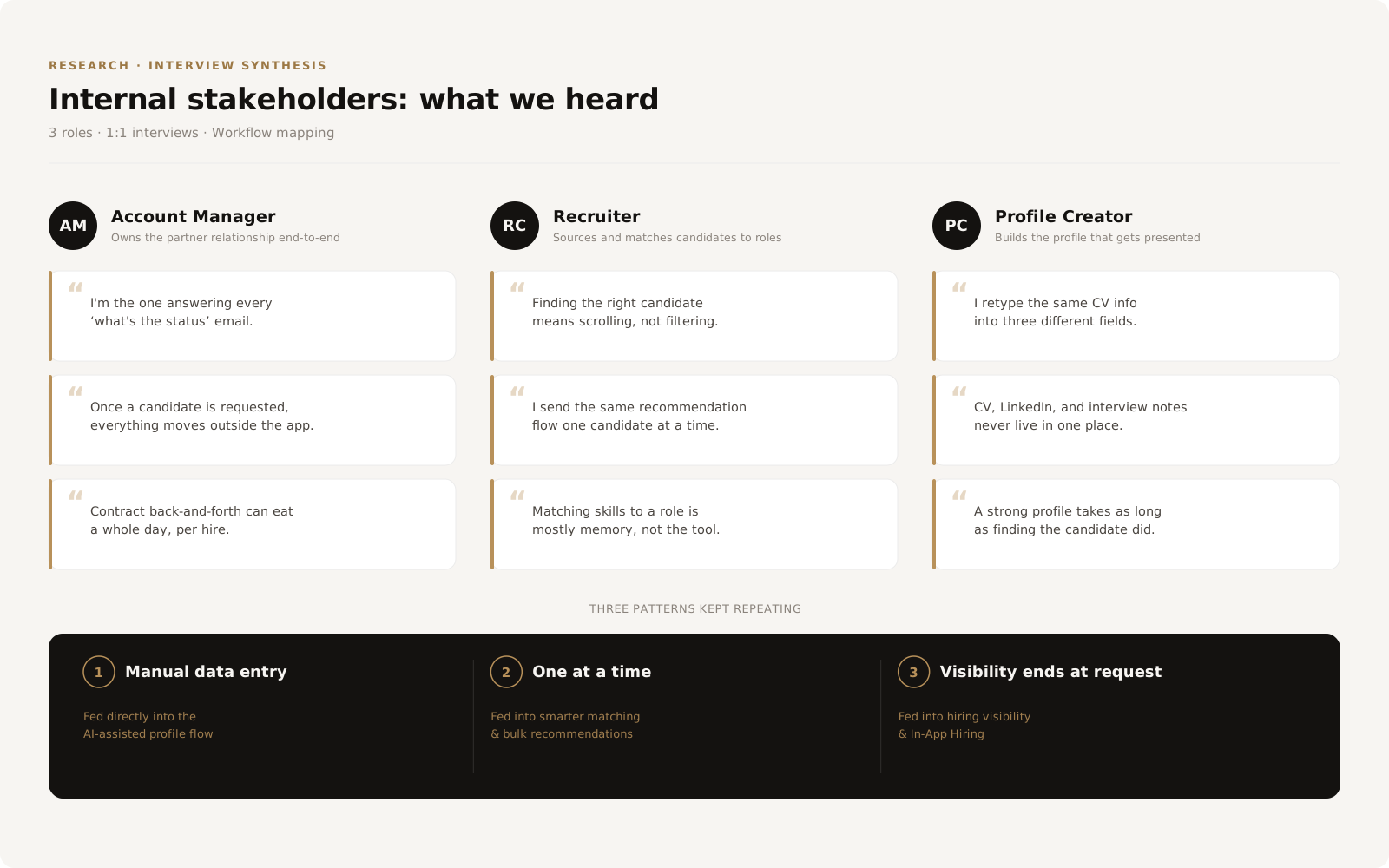
Synthesis from 1:1 interviews with Account Managers, Recruiters, and Profile Creators — three recurring patterns shaped the solution
Solution
What I shipped, on both sides
Every change traced back to the same goal — present more candidates, faster, with less manual work in between. Four changes on the internal side, and one on the partner side that changed what the app was actually for.
Internal — Admin
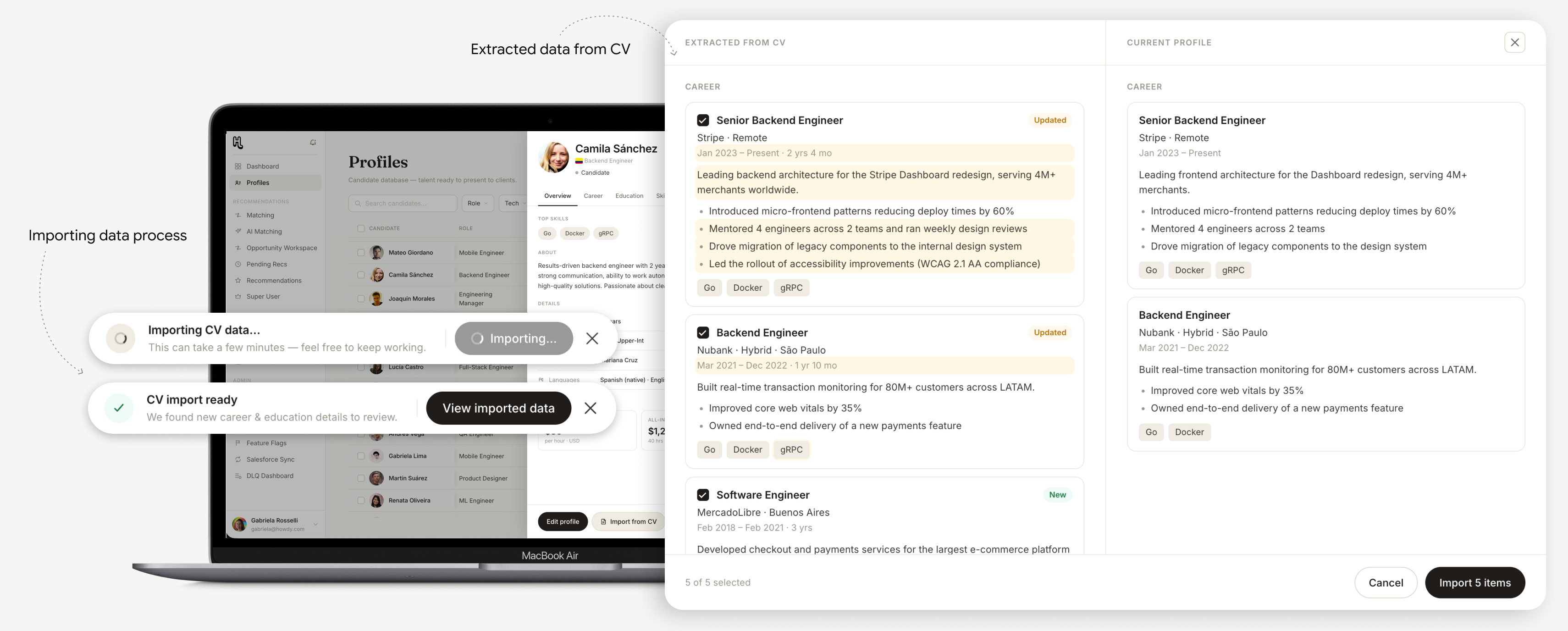
AI-assisted profile building
Instead of Recruiters and Profile Creators typing candidate data in by hand, the new flow pulls information directly from CVs, LinkedIn, and interview notes — cutting the manual work of assembling a profile down to reviewing and confirming it.
AI Matching
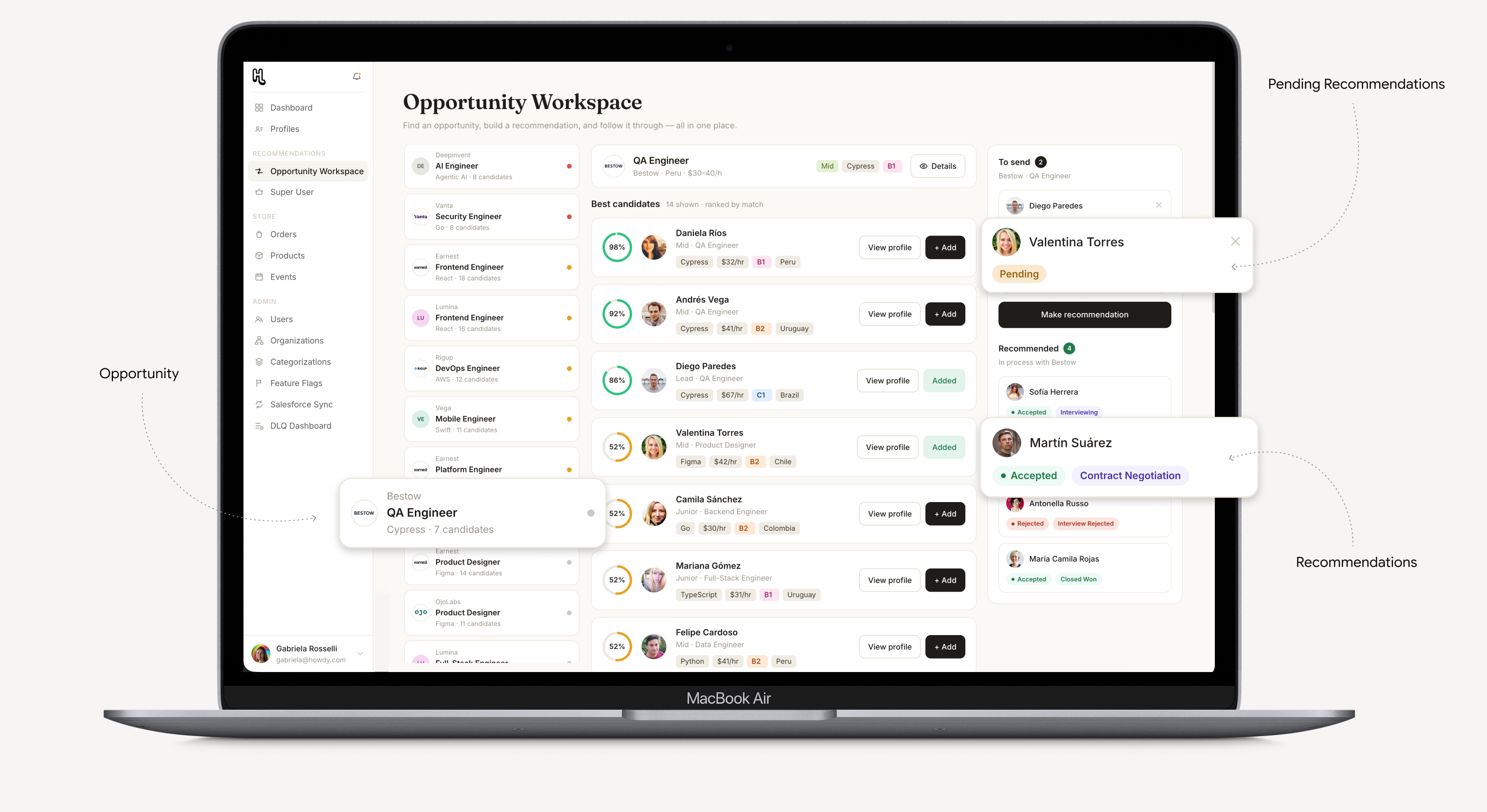
Matching a candidate to an opportunity used to mean scrolling and cross-checking skills by hand. Now AI scans the opportunity — the partner's specific request for a role — against every candidate's profile, and automatically generates the match, returning a ranked list sorted from highest to lowest match percentage.
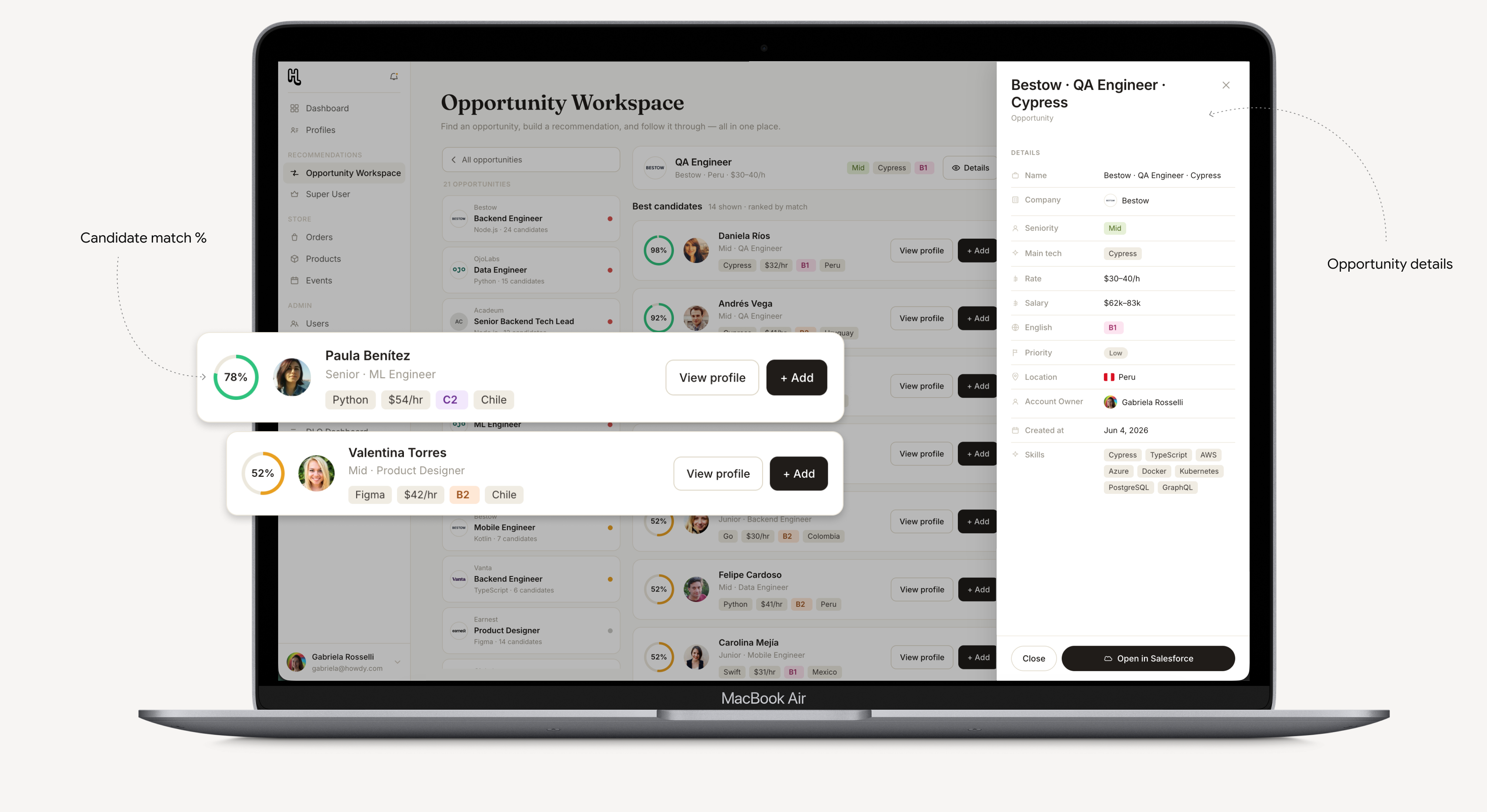
Opportunity Workspace
Proposed a single new section to replace three separate ones — Matching, Pending Recs, and Recommendations. Finding an opportunity, creating a recommendation, and following up on it now happen in one place, powered by AI Matching's ranked results and feeding directly into hiring visibility.
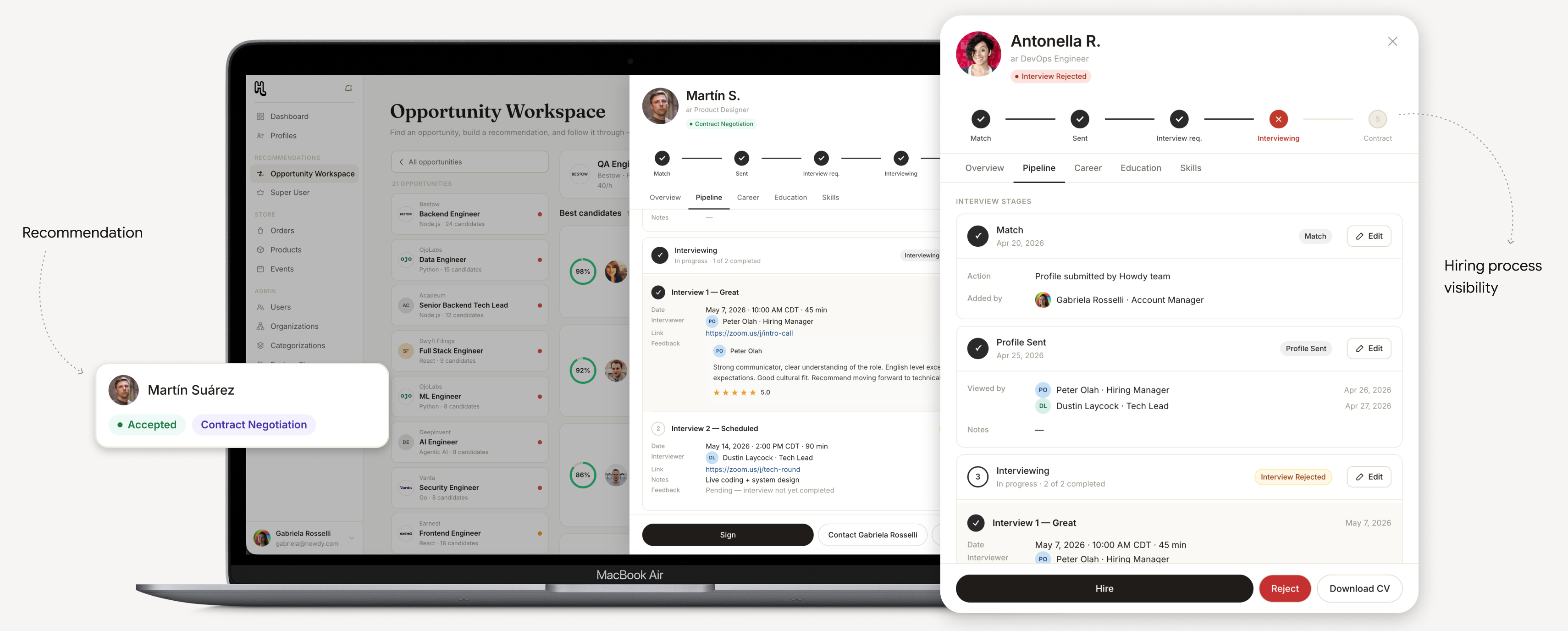
Hiring visibility
Centralized every step of the hiring process — presentation, acceptance or rejection, and the full interview flow, with dates, participants, channel, and feedback — into one place instead of scattered notes.
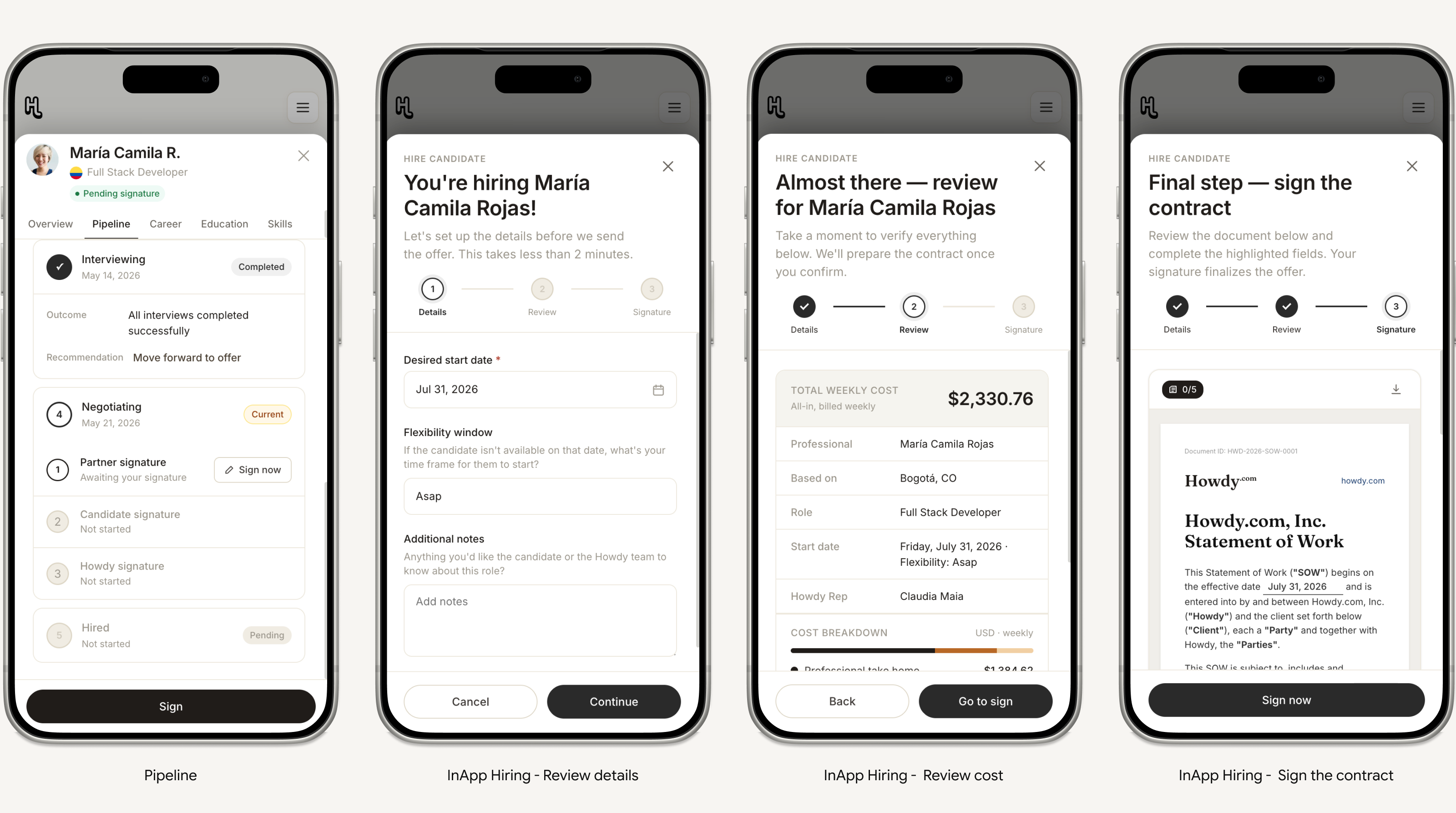
External — Howdy App
Partners could already request candidates from the app — but the moment a candidate was requested, the process moved to email and phone calls with an Account Manager. I built In-App Hiring (IAH) so the app could carry the process all the way through: partners track the full interview pipeline, and now sign the contract online — waiting on signatures from both Howdy and the candidate — without ever leaving the app.
Results
Closer to 600
These figures are illustrative — modeled on the shape of the improvement rather than exact reported numbers — but they reflect what actually moved: every process got faster, and the app started carrying weight it never used to.
Modeled on Ops and partner activity over the redesign period. The HP goal reflects the platform's overall placement target, which this work contributed to alongside sourcing, sales, and account growth — not a number this redesign alone produced.
Key results
Beyond the metrics, this work also reframed what the Howdy App was for. Before In-App Hiring, it was a place to request candidates and then wait. Now it's where the hire actually happens — which is the difference between a tool partners check occasionally and one they depend on.
Reflection
What's next on the way to 600
Doubling the HP goal isn't a single redesign's job — it's a target the whole company works toward, and design's role is to keep removing the friction that sits between a good candidate and an active placement. This phase closed the biggest gaps I could see: manual profile building, one-at-a-time recommendations, and a hiring process that left the app halfway through.
What's still ahead: